




The Decline of Black Friday The Data Behind Britain's Changing Shopping Habits
UK searches across a basket of Black Friday terms are down more than a third (36%) on their 2019 peak.
Has Black Friday lost its magic?
At its peak, Black Friday was treated as a huge national event, with many queuing up for hours outside shops before dawn and websites crashing due to high demand. But today, consumer interest in Black Friday is fading, and the data proves it.
To see how much UK shoppers' interest in Black Friday has changed, we compared Google Trends data and estimated search volumes for 19 of the most-searched Black Friday terms, looking at November 2019 and November 2025.
We found that overall, UK searches for Black Friday have fallen by more than a third (36%) since their 2019 peak, while searches for deals and named retailers have also dropped, and searches asking when Black Friday starts and ends have risen. That shift raises interesting questions for brands that still plan Q4 budgets around a single weekend.
What the searches tell us
UK searches for "Black Friday" have fallen by over a third (36%) between November 2019 and November 2025, according to Google Trends.
There are 40% fewer searches for Black Friday deal terms, such as "black friday deals" and "best black friday deals".
Black Friday searches naming specific retailers, such as Argos, Amazon, John Lewis or Boots, have dropped by over two-thirds (68%) between November 2019 and November 2025.
The numbers behind Black Friday's decline
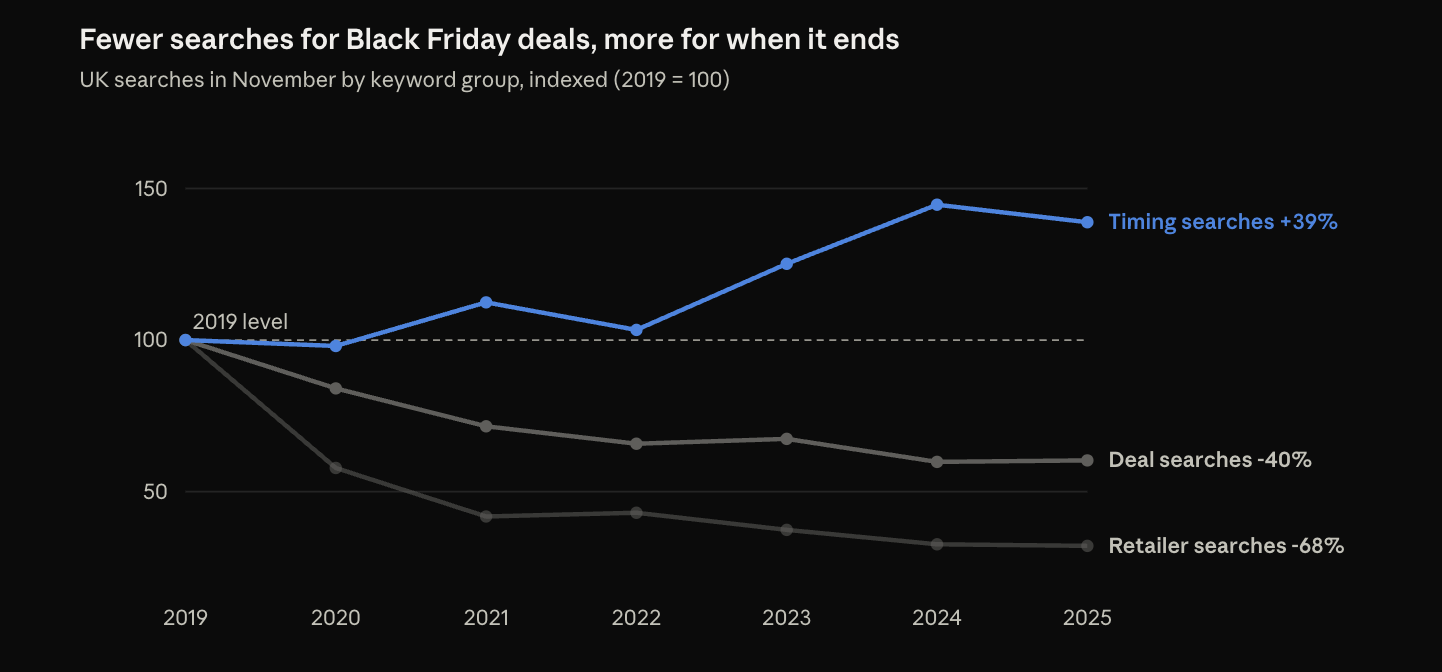
Deal and retailer-specific searches have fallen since 2019, while timing searches have grown massively, with most of that increase coming since 2023.
Black Friday searches broken down by keyword, ranked by the biggest drop:
| Keyword | Nov 2019 | Nov 2025 | Change |
|---|---|---|---|
| john lewis black friday | 241,434 | 38,491 | -84% |
| argos black friday | 478,746 | 102,483 | -79% |
| currys black friday | 546,754 | 126,389 | -77% |
| black friday deals uk | 134,634 | 35,793 | -73% |
| black friday tv deals | 115,227 | 41,775 | -64% |
| black friday uk | 185,163 | 81,447 | -56% |
| boots black friday | 163,655 | 79,887 | -51% |
| amazon black friday | 297,000 | 158,319 | -47% |
| black friday deals | 1,135,000 | 629,313 | -45% |
| best black friday deals | 229,658 | 148,725 | -35% |
| apple black friday | 50,165 | 36,442 | -27% |
| black friday sales | 217,158 | 160,383 | -26% |
| when is black friday uk | 90,914 | 74,970 | -18% |
| black friday date | 37,146 | 33,904 | -9% |
| black friday sale | 159,644 | 187,341 | +17% |
| when is black friday | 933,056 | 1,306,071 | +40% |
| lego black friday | 24,231 | 40,813 | +68% |
| when does black friday start | 15,903 | 35,231 | +122% |
| when does black friday end | 11,347 | 61,144 | +439% |
A breakdown of Black Friday search terms sorted from the biggest fall to the biggest rise. Estimated UK searches in November each year (Ahrefs). Data collected in October 2026.
The biggest drop came in 2020
The largest year-on-year fall came between 2019 and 2020, which is interesting considering this was when many people were staying at home and spending more online due to the pandemic. You would think that searches during this time would have increased rather than dropped.
Since 2021, online searches for Black Friday have stayed at a similar, but lower level each year, which means that 2019 now stands out as the peak.
Shoppers have swapped the term "deals" for "sales"
Searches for the term "black friday deals" have nearly halved since 2019, from around 1.1 million in November 2019 to just 630,000 in November 2025, and across six deal-related terms, searches are down by 40%. Interestingly, one exception is "black friday sale", which has actually grown by 17%, so some people are still searching for deals, just in a different way.
This fall suggests that shoppers are more sceptical about Black Friday offers, and with research by consumer groups showing that many items are often cheaper at earlier points in the year, the event often doesn't feel as special as it once was.
Searches including retailers have fallen most
Interestingly, searches pairing the term Black Friday with a major retailer show the biggest falls. Overall searches across Argos, Amazon, John Lewis and Boots have fallen by two-thirds; "John Lewis black friday" is down by 84%, and "Argos black friday" is down by 79%, for example. Many retailers now run sales across several weeks or throughout the whole of November instead, which may mean fewer shoppers are searching for a single Black Friday event.
Today's shoppers are becoming smarter and more informed as they have access to price comparison websites and browser extensions, where they're able to find an item's price history, competitor prices, reviews and alternative products. This can make it harder for retailers to stand out with a single sale event.
More people are asking when Black Friday starts and ends
The biggest change can be seen around timing. While overall interest is fading, there is more interest in when Black Friday actually starts and ends. With most Black Friday sales now spread over several weeks, and some starting as early as October, shoppers are less excited by the event and appear less sure when the event actually begins and ends, and this shows in their searches.
Online searches asking when Black Friday is, when it starts or when it ends have risen by almost two-fifths (39%). For example, the term "When does Black Friday end" has grown by 439% - from 11,000 to 61,000 searches, and "when does Black Friday start" has more than doubled since 2019.
Is Black Friday still worth the advertising cost?
UK advertising spend increased by 7.3% to around £12 billion over the wider festive season, from October to December 2025, and this heavily involved Black Friday promotions, according to the AA/WARC Expenditure Report in 2025. But is it still worth the advertising cost if consumer interest is falling?
Cheaper products cost more to advertise
To see how ad costs compare across Black Friday's most popular searches, we looked at estimated cost per click (CPC) for searches across clothing, beauty, tech and home, and compared each one with the lowest, widely reported Black Friday 2025 product price for a popular product in that category.
Most clicks were estimated to cost between 35p and £1.10, meaning the product price made most of the difference in relative advertising efficiency. We found that clothing came out on top as the most expensive category to advertise relative to product retail price. A click for "gymshark black friday" costs around 70p, which equals 3.1% of the £22.50 Black Friday product price of Gymshark's Vital Seamless leggings, for example, while a click for "ps5 black friday deals" costs 36p, less than 0.1% of the PS5's £379 retail price. Compared with what the product sells for, advertising an entry-level item like leggings costs roughly 33 times more per click than advertising a console.
This is partly because of how shoppers search across different categories. Clothing and beauty shoppers rarely search for specific product models - instead, they tend to search broadly for brand deals, such as "charlotte tilbury black friday" or "lululemon black friday", and so that single brand-level click must carry the weight of the brand's entire entry-level range.
Of course, high CPCs on lower-priced products are often an intentional strategy. Retailers frequently use low-priced, popular items as loss leaders. Where brands accept low or non-existent margins on these entry items to drive massive site traffic, relying on cross-selling and consumers adding full-margin items to the cart to make the campaign profitable overall.
For retailers relying on single-item sales without cross-selling, however, lower-priced products leave far less breathing room. The Black Friday price of a PS5 covers roughly 1,050 clicks, compared with just 32 for a pair of Gymshark leggings, for example.
Travel searches had the highest absolute click costs of all - "black friday holiday deals" was estimated at around £1.44 a click, though holidays lack a single standardised product price for direct comparison.
Estimated ad cost vs Black Friday 2025 product price
| Category | Product | Example search | Black Friday Product Price (2025) | Est. CPC | CPC as % of retail price |
|---|---|---|---|---|---|
| Clothing | Gymshark Vital Seamless leggings | gymshark black friday | £22.50 | £0.70 | |
| Clothing | lululemon Align leggings | lululemon black friday | £34 | £0.76 | |
| Beauty | Charlotte Tilbury Magic Cream | charlotte tilbury black friday | £63 | £0.62 | |
| Beauty | Dyson Airwrap i.d. | dyson airwrap black friday | £329.99 | £0.59 | |
| Tech | Ring Battery Doorbell | ring doorbell black friday | £39.99 | £1.10 | |
| Tech | iPad (A16) | ipad black friday deals | £299 | £0.74 | |
| Tech | iPhone 17 (256GB)* | iphone black friday deals | £799 | £0.98 | |
| Tech | PS5 Slim (disc) | ps5 black friday deals | £379 | £0.36 | |
| Home & kitchen | Ninja Dual Zone air fryer | ninja air fryer black friday | £128 | £0.51 |
* No Black Friday discount was found, so the normal UK price is shown.
The estimated cost per click (CPC) is for UK searches, such as the example shown. It's a market estimate for the search term, not what a brand or retailer paid. Prices are the lowest widely reported UK Black Friday 2025 prices for each product.
Black Friday is still a huge moment for UK retail, but the way people search for it has definitely changed. Fewer people are typing in generic phrases like 'Black Friday deals', and more are asking when the sales start and finish. Shoppers know the event is coming, but they're just planning around a longer window rather than one day.
That matters for advertisers because a lot of Q4 planning is still built around Black Friday weekend itself. If demand is spread across November, putting most of the budget into a few days means competing for clicks when ad space is usually most contested, and potentially missing the shoppers who started looking earlier.
Lower-priced products feel this the most. A click on a Gymshark search, for example, costs more than one on a PS5 search, even though the leggings sell for a fraction of the price. There's much less room for wasted spend on cheaper products, so tight keyword targeting in lower-priced categories like clothing matters even more.
Before setting this year's budget, it's worth looking at your own search and sales data from the last few Novembers to see when your customers actually spend their money. Spreading spend across the month, testing earlier activity, and giving more weight to product and brand terms than broad Black Friday phrases will usually show you more clearly where the demand is, so you can plan accordingly. The rise in searches such as 'when does Black Friday end' is also a reminder to make your start and end dates obvious in ads and on site.
Laura's Black Friday tips for advertisers
Planning Your Q4 Paid Search?
If you'd like a second opinion on where your Black Friday budget should go this year, get in touch with our PPC team.
Get in Touch →Methodology & Sources
We analysed UK search interest in Black Friday in November 2019 and November 2025. November is the month Black Friday falls in each year (29 November 2019 and 28 November 2025).
- Overall searches: The headline 36% figure comes from Google Trends, using UK web search interest in the search term "black friday" with monthly data from January 2019 to December 2025. November 2019 was the highest point in the period (scored 100), and November 2025 scored 64. Every November since 2019 has scored lower.
- Keyword data: Estimated UK monthly search volumes for 19 high-volume Black Friday keywords were taken from Ahrefs in October 2026. Keywords were chosen from the most-searched Black Friday terms in the UK. Terms that include a specific year (for example, "black friday 2025") were left out so the same keyword could be compared across both years.
- Keyword groups: Deal terms are "black friday deals", "black friday deals uk", "best black friday deals", "black friday sales", "black friday sale" and "black friday uk". Retailer terms are Black Friday searches, which include Argos, Amazon, John Lewis, and Boots. Timing terms are "when is black friday", "when is black friday uk", "black friday date", "when does black friday start" and "when does black friday end".
- Product ad costs: Estimated CPCs were taken from Semrush (UK database) in October 2026. These are current estimates, not the prices advertisers paid in November 2025. For tech and home, we used the highest-volume product searches that include "black friday", for example "ps5 black friday deals". Product-level Black Friday searches in clothing and beauty had little or no CPC data, so for those categories, we used brand searches and priced each brand's best-known product. Prices are the lowest widely reported UK Black Friday 2025 prices for each product's most common model, taken from published deal coverage. Where no Black Friday discount was found, the normal UK price was used. Travel is included for CPC only, as holidays and flights don't have a single comparable price.