




How to Master Digital PR in the US

UK Digital PR teams are used to quick results – you send a pitch on a Tuesday, and it can be live on a handful of national, trade or regional sites by Thursday afternoon, depending on the subject. It can be even quicker if it’s in reaction to a trending news topic, such as a heatwave, the Autumn Budget or spider season.
But try this in the US, and you may not see your story live for weeks or sometimes months. BuzzStream’s State of Digital PR 2026 report found that 70% of UK Digital PR professionals get coverage within five days. In the US, only 37.2% said they saw coverage within that timeframe, and around 60% say that it can take between one and three weeks to see coverage. Part of the reason is how differently the US media works. It’s split across 50 states, heavily commercial, and much more crowded, with up to seven PR professionals competing for every journalist.
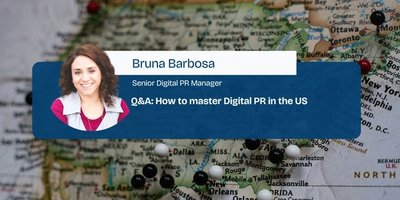
We asked Bruna Barbosa, our Senior Digital PR Manager, who lives and works in America, for her take on mastering Digital PR in the US. She has over ten years of publicity experience, six in Digital PR, and has led her own team of Digital PR specialists, data analysts, and designers in the US, helping place data-led content in top-tier publications across industries. Here, she covers what caught her out early in her career, how pitches differ, and what she would tell a junior before running their first US campaign.
Key takeaways
- The US has fewer journalists per head than the UK. There’s roughly one for every 3,840 residents, compared with one for every 1,280 here, so expect much more competition for each inbox.
- Lifestyle titles and regional and local press are the most reliable targets. National outlets only tend to bite when a story has broad cultural relevance or real breaking news value.
- Don’t paste the press release into the email – Send a short, bulleted pitch and link to a media kit with the raw data and graphics. Only 11.6% of US Digital PR professionals paste releases into the email body.
- Write subject lines for a phone screen, keep them short, and put your strongest number first.
- Keep the data simple – If you can’t explain the finding to a friend in a sentence or two, it needs simplifying.
- UK-led data can work, but it needs a US hook. Framing it as “how the US compares” or breaking it down by state gives you up to 50 local angles.
- Time your sends to the newsdesk’s time zone. Early morning and 11.30am to 2.30pm ET work well, and avoid anything close to 5pm.
- Don’t judge a new brand on its first campaign – Trust builds as journalists keep seeing your name next to good data.
- Agree upfront on how you’ll count syndication. A single regional hit can lead to 30 to 50 pickups across networks such as Tribune, Patch, and Yahoo.
- Don’t assume a trend is universal. What’s all over your feed may mean nothing to a journalist or their readers. Make it work for them and what their readers would care about.
| Dimension | United States | United Kingdom |
|---|---|---|
| Journalist Density | ~1 per 3,840 residents | ~1 per 1,280 residents |
| PR-to-Journalist Ratio | 1.8:1 to 7.2:1 | 1.2:1 to 1.5:1 |
| Pitch Format Preference | Short, bulleted pitch with links/media kits/graphics | Full, copy-paste-ready press release in body |
| Core Data Preference | Simple, state-by-state, hyper-local | Innovative, multi-variable, national scope |
| Media Reach Driver | Regional affiliate syndication networks | High-volume national online verticals |
On the media landscape
- What’s the biggest structural difference between the US and UK media landscape that catches people out, whether that’s the sheer number of regional and trade titles, how syndication works, or how fragmented coverage is across states?
We often assume that because the US is a massive country, it naturally has more journalists, but that isn’t true on a per-capita basis. According to a recent BuzzStream report, there is roughly one journalist per 1,280 residents in the UK compared to one per 3,840 in the US. When accounting for PR professionals, you are looking at anywhere from 1.8 to 7.2 PR pros per journalist in the US, while in the UK, it is a fairer 1.2 to 1.5 ratio.
Structurally, the UK landscape is made up of high-volume national publishers and broadcasting giants. The US, on the other hand, is fragmented, commercial, and subscription-driven. This creates a market that is saturated, competitive for journalists’ attention, and focused on immediate ROI and monetization potential.
- Which types of publication tend to be most open to Digital PR pitches in the US, national, trade, or local and regional press, and does that differ much from what works in the UK?
In the US, the most consistent success comes from lifestyle publications and regional/local press (where hyper-local angles thrive). US national verticals can be hit-or-miss unless your story has broad cultural relevance or massive breaking news value.
In contrast, the UK market is remarkably receptive to Digital PR across national consumer verticals (e.g., Reach plc titles, The Sun, The Independent) because UK online newsrooms operate at high publishing volumes and look for quick, data-driven consumer stories.
On pitching and journalist relationships
- How do US journalists prefer to be pitched, and is there anything about tone, subject lines, or follow-up etiquette that a UK-trained PR should unlearn before pitching into the US market?
In the US, conciseness is important. Because American journalists are inundated with pitches, your email must establish the hook, the core story, and why it matters to the public within the first few sentences.
There are three pillars to a great pitch, especially in the US market: subject lines, tone and emotion, and format.
Subject lines are perhaps the most important aspect. It must state the story at a glance. Many journalists open their emails on their phones, so they have to be short to make sure they don’t get cut off. Concrete details and numbers should be handpicked to showcase the most impactful insights and front-loaded rather than hidden.
I always try to match my tone to the subject and tap into an underlying emotion, whether that’s curiosity, levity, or shock. Journalists want that golden nugget that surprises or makes something memorable to their audience.
While UK journalists often appreciate a full, copy-paste-ready press release pasted into the email body, US journalists prefer a punchy, bulleted “elevator-style pitch” up front, with a media kit that includes raw data and graphics they can use in a pinch.
What the data says
The two markets treat press releases very differently. According to BuzzStream’s State of Digital PR 2026 report, 98.8% of UK Digital PR professionals count press release pitching as part of Digital PR, compared with 69.8% in the US, while newswires are far more common in the US. Over two-thirds (67.5%) use them at least sometimes, against just 13% in the UK.
- Time zones span the whole US. How does that change when and how you send pitches, and does it affect which regions or publications you prioritise first?
With four major continental time zones in the US (a three-hour spread between East and West Coasts, and up to six hours for Hawaii and Alaska), timing requires strategy. It’s good to think about when journalists will need a story, when their inboxes might stall a little, and when your pitch can come out on top. Pitching first thing in the morning is standard, but post-lunch windows have high conversion rates for me (e.g., starting at 11:30 AM EST and rolling through 2:30 PM EST/PST). I avoid pitching near 5:00 PM in any zone, and I prioritize outreach based on vertical alignment first, adjusting send times to match the primary location of the publication’s newsdesk.
- Do you need to build personal relationships with journalists to land coverage, or is consistency enough?
Momentum in Digital PR comes down to brand recognition rather than traditional relationship building. When a brand is new to the space, the first campaigns rarely perform well, unless the story is extremely newsworthy and sound. However, as journalists repeatedly see your name pop up with quality data, trust builds naturally. It’s less about making friends and more about establishing consistency and authority.
What the data says
Close relationships may matter less, but personalisation still counts. BuzzStream found that 58.1% of US Digital PR professionals always personalise their pitches, compared with 42.4% in the UK. US respondents were also around twice as likely to mention something from a journalist’s bio. It can also take longer to see a return. Only 23.3% of US respondents see measurable results within one to three months, compared with about 41% in the UK.
On story angles and data
- What kind of story or data angle tends to land well with US journalists that might not work as well in the UK, and are there topics or framings that fall flat over there?
Hyper-local data, state-by-state comparisons, holiday/seasonal themes, and straightforward statistics perform exceptionally well in the US.
A golden rule for the US is: keep the data simple. Innovation wins in the UK, but clarity wins in the US. If a dataset requires a journalist to cross-reference five different metrics to understand the point, it will be discarded. That’s not to say a piece can’t be innovative in the US, but it has to make sense in very few sentences (remember: the pitches are short). When pushing the boundaries, I let one strong, clean visual or statistic tell the story. More isn’t always better.
A good, quick pulse point is this: Does it make sense to you if you skimmed it? Could you tell it to a friend in one or two sentences, and they’ll be able to understand it? If not, simplify it.
And always use your own emotions towards a piece to guide you. If you’re having trouble tying the points and feel frustrated, chances are, so will the journalists. In the US, when you’re competing with at least seven others trying to reach the same journalist, clarity can make you stand out.
What the data says
Health brands may need to work harder in the US – BuzzStream found that 39.5% of US Digital PR professionals named health and wellness as the hardest sector to get coverage in, compared with 11.8% in the UK.
- Do you need US-specific data, or a US angle on existing data, to get real traction with American journalists, or can a strong UK-led study still travel well?
It doesn’t have to be 100% US-exclusive, but there must be a US hook. American readers are inherently curious about how their habits compare to those of other states or the rest of the world. Global data works best when framed as “How the US compares to X.”
Content that delivers in all 50 states also tends to perform well. It doesn’t have to be “best of” or “worst of” lists. Each state is different and has different behaviours that you can tap into. By offering fresh, purposeful data for each region, you create 50 angles tailored to media pitches. If there is something that only you can provide the data for, then that’s even a bigger win, as that content can be updated every single year. The goal here is to make sure the brand you’re working with becomes the expert in the data you’re providing.
On tools, process and measurement
- Are there tools, databases or platforms you rely on for the US market that aren’t as widely used, or don’t exist, in the UK?
Broadcast media is significant in the US, so monitoring platforms like Meltwater, Critical Mention, and Cision are essential for capturing TV/radio pickups. For database outreach, platforms like Muck Rack are industry standards in the US. Headline-analyzing tools like CoSchedule also help optimize subject line length and scannability.
What the data says
AI is now part of the pitching process for most US teams. About 85% of US respondents use AI to help write pitches at least sometimes, compared with about 50% in the UK, according to BuzzStream.
- How do you judge whether a US Digital PR campaign has actually worked? Is it the same metrics you’d use in the UK, such as links and domain authority, or does success look different over there?
While Domain Authority and raw link totals are universal KPIs, US campaigns rely heavily on syndication networks (e.g., Tribune, Patch, Yahoo). A single regional hit in the US can trigger 30–50 syndicated pickups across affiliate sites, which boosts reach significantly compared to the more centralized UK media landscape. It’s down to agency preference, in the end, on how they measure syndications. I’ve seen some who count all, and some who count only the original coverage that got syndicated.
What the data says
US teams also report higher link volumes. BuzzStream found that 51.2% of US Digital PR professionals build 31 or more links a month, compared with 25.9% in the UK.
On lessons learned
- What’s a mistake you made early on when working on US campaigns, or one you see juniors make often, and what would you do differently?
Assuming that journalists and the public know of a trend. With social media algorithms, especially, you have to be careful. Something that might be trending on your feed doesn’t necessarily mean it’s trending for everyone, and something that might be common within your generation doesn’t mean it’s common for everyone else. So always be mindful of trendy behaviours or words. Do your research, and if you’re unsure, ensure the story is accessible and clear to most.
- If you could give one piece of advice to someone running their first US Digital PR campaign, what would it be?
Don’t overcomplicate it, present something genuinely new, front-load the data, and tap into a clear human emotion.
Most of what works in UK Digital PR still works in the US – Journalists in both countries want a strong story, clean data and a concise pitch. The difference is how little space you get to make your case. With more PRs chasing fewer journalists, a US pitch has a few sentences to land. The story needs to make sense on a phone, and it needs to matter to readers in a specific state or city.
Final thoughts
It also pays to be patient. Coverage can take weeks rather than days, and a brand’s first US campaign is rarely its best. Bruna’s advice is to keep showing up with consistent, well-sourced data. That’s how journalists start to recognise your name and come back for more.


Let’s create your future growth plan
Get My Growth PlanRelated Playbooks
 No. 01Commerce3,412 words13 min read
A Visibility Playbook for E-commerce
Why above-the-fold organic CTR has collapsed, and how to make PDPs and PLPs work as both conversion assets and AI citations in 2027.
Read More No. 06B2B3,392 words13 min read
A Visibility Playbook for SaaS Websites
Documentation as a citation surface. Integration pages as commercial assets. The 2027 SaaS visibility playbook.
Read More No. 04B2B3,588 words14 min read
A Visibility Playbook for B2B Lead Generation
Pipeline attribution is broken. The visibility framework that works on a 6–18 month sales cycle in 2027.
Read More
More articles we
think you’ll like
 7 min read
Digital PR strategy for AI search: getting cited by ChatGPT
How we find the publications AI assistants cite for your category, earn coverage in them and make sure every story describes your brand in one quotable line.
Continue Reading 7 min read
How we build data-led digital PR campaigns that earn coverage
The method behind our data-led digital PR campaigns, from sourcing original data and testing angles to regional cuts and tracking every link back to the page it supports.
Continue Reading 7 min read
Reactive PR in practice: turning breaking news into links
How we run reactive PR day to day, from the morning news scan and the credibility test to one-hour sign-off, and why the first usable expert quote usually wins the coverage.
Continue Reading 13 min read
How to pitch a journalist: What an ex-Reach PLC pro really thinks of your pitch
As a Digital PR specialist, getting the unfiltered truth about your work from a seasoned journalist is a rarity. It’s even rarer to have one on your team AND get a chance to interview them.
Continue Reading 19 min read
What is Digital PR? Strategy, Benefits & Launching a Campaign
Traditional PR lives in newspapers, magazines, and TV interviews. The problem? That’s not where audiences are now spending the majority of their time.
Continue Reading 6 min read
10 ways to manage stress and improve your mental health in the PR industry
Burnout in the PR industry is high. PRs often work long hours, manage multiple relationships – including clients with high expectations, and face a lot of rejection and criticism. While poor mental health is not just an issue in PR, there are certain norms specific to the industry which don’t help. Such as the ‘always on’ mentality and the pressure to deliver high quality results and hit key targets.
Continue Reading 7 min read
The must-have tools for any Digital PR pro
Digital PR is tough. Not only are you in competition with every other PR, fighting for the attention of journalists whose time is short and inboxes are full. But you’re also fighting against the broader news cycle. Sometimes there are things going on that you just can’t control. Resulting in your campaign or story getting buried as journalists rush to cover the big event of the day, week or month.
Continue Reading 8 min read
SEO forecasting your finance director will believe
How to build an SEO forecast and business case that survives a finance review: stated assumptions, your own data, three scenarios, payback and tracking against actuals.
Continue Reading 8 min read
SEO reporting for the board: the KPIs a marketing director should own
The SEO KPIs a board needs: non-brand revenue and new customers, share of search, AI visibility, leading indicators with context, and cost and payback on one page.
Continue Reading